

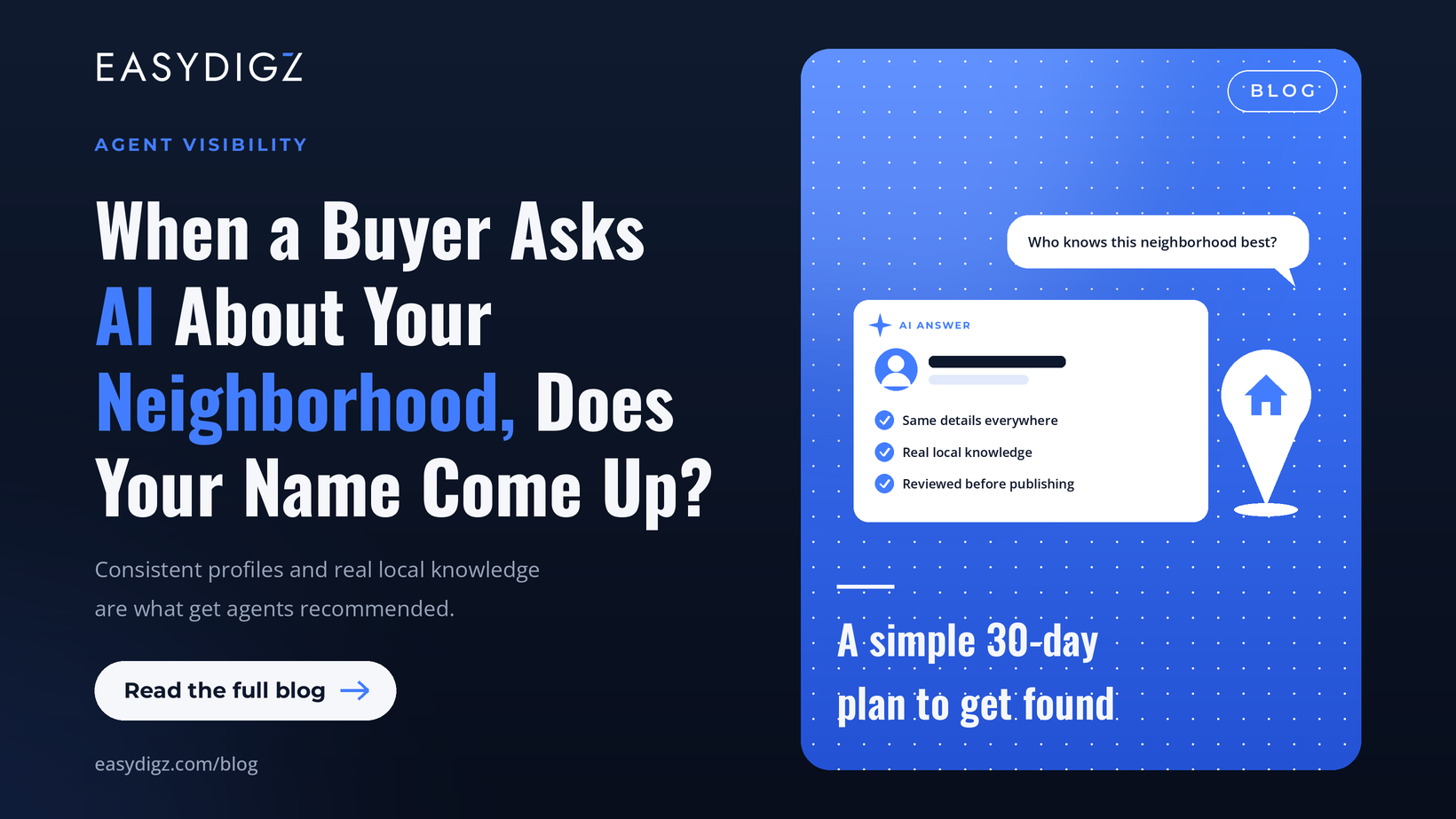
More buyers now start their search by asking an AI tool a question instead of typing a few words into a search bar. They ask which neighborhoods fit their commute, what an area is really like and which agent knows it best. The agents who come up in those answers usually have two things in common: their information is the same everywhere it appears online, and they publish specific, useful content about the places they genuinely know.
This shift is already showing up in survey data. In a Veterans United Home Loans survey of 859 people conducted in June 2026, 45% of prospective buyers said they had used AI tools in their home search, up from 37% a year earlier. Searching for homes was the most common use, cited by 52% of those buyers.
How AI tools decide who to mention
When a buyer asks an AI tool about an agent, the tool pieces together a picture from many places at once: the agent's business profile, reviews, license record, MLS profile and listing pages. If the name, phone number, office address and website differ from one profile to the next, the tool has to work harder to confirm it is looking at the same person. The harder it has to work, the less confident it is in recommending that agent.
Most agents never set out to have inconsistent profiles. A phone number changes, a brokerage moves offices, an old directory listing never gets updated. Over a few years those small gaps add up, and they quietly make an agent harder to recommend.
Start with one source of truth
The first fix is to pick one place that holds the correct, complete version of an agent's business, usually their own website, and make every other profile match it and link back to it. That means the same name spelled the same way, the same phone number, the same office address and the same license details everywhere. When every profile tells the same story, both search engines and AI tools see one clear business instead of several partial ones.
This is also where the brokerage can help. When agent sites and profiles are tied to the brokerage's own system, keeping them consistent becomes a shared standard instead of a task each agent has to remember.
Write about the places you actually know
General information about a neighborhood is easy for anyone to find, so it does nothing to set an agent apart. What AI tools and buyers both value is the local detail that only someone who works an area can supply: realistic commute times at rush hour, what HOA transfer fees look like, which parks and amenities people actually use and how a neighborhood's sales have moved over the past year.
A practical way to start is to take one specific question a buyer has asked about a neighborhood and answer it in a short post, using local market data from the past 12 months to support the answer. One clear, accurate post about a place an agent knows well is worth more than a dozen generic ones.
Review every word before it goes live
Agents remain responsible for everything they publish, no matter which tool helped write the first draft. That matters most with neighborhood content, where well-meaning phrases can create fair housing problems. Descriptions such as "great for families with children" or "a safe area" describe the people who live somewhere rather than the place itself.
A simple habit helps: read every draft out loud and stop whenever it describes people instead of the property, the streets or the amenities. Agents should also follow MLS display rules when featuring other brokers' listings and keep client information out of free AI tools entirely.
Consistency beats volume
Search engines and AI tools reward patterns, so steady and accurate beats occasional and loud. A realistic 30-day plan looks like this:
Align every profile with the one source of truth.
Publish a first post that shows real expertise in one area or property type.
Earn mentions from others in the industry, such as lenders, inspectors and local partners.
Ask an AI tool about yourself and your area, then fix the gaps it reveals.
Being found is only the first step
Showing up in an AI answer gets an agent a chance at the first conversation. What happens next depends on the experience the client has once they reach out: how quickly someone responds, whether the agent already knows their history and whether every step after that feels consistent. That is why the foundation matters more than any single tool. When client records, marketing and transactions live in one connected system, AI can amplify a business that already works. Without that foundation, it mostly helps buyers find the gaps faster.
Key Takeaways
In a June 2026 survey, 45% of prospective buyers said they had used AI tools in their home search, up from 37% a year earlier.
AI tools build their picture of an agent from many profiles at once, so mismatched names, phone numbers and addresses make an agent harder to recommend.
Choose one source of truth, usually the agent's own website, and make every other profile match it and link back to it.
Specific local knowledge, backed by recent local data, sets an agent apart in a way general neighborhood information cannot.
Review every draft for fair housing language and describe the place, never the people.
Being found only opens the door; the client experience after the first contact is what earns the business.
Frequently Asked Questions
Do agents need special software to show up in AI answers? Usually not. The basics matter far more than any special tool. Consistent profiles, a clear source of truth and useful local content are the foundation that AI tools draw on.
How often should an agent publish neighborhood content? A steady, sustainable pace works better than bursts of activity. One accurate, specific post that answers a real buyer question is a strong start, followed by regular updates as the market changes.
Can agents use AI to help write neighborhood content? Yes, many do, but the agent is still responsible for everything that gets published. Every draft should be checked for accuracy, MLS display rules and fair housing language before it goes live, and client information should never be entered into free AI tools.
What is the most common fair housing mistake in neighborhood content? One of the most common mistakes is describing who lives in an area rather than the area itself. Phrases about families, safety or the type of people in a neighborhood should be replaced with facts about the homes, streets, amenities and commute.
Want your agents to be found and ready when buyers reach out? Talk it through with EasyDigz.