

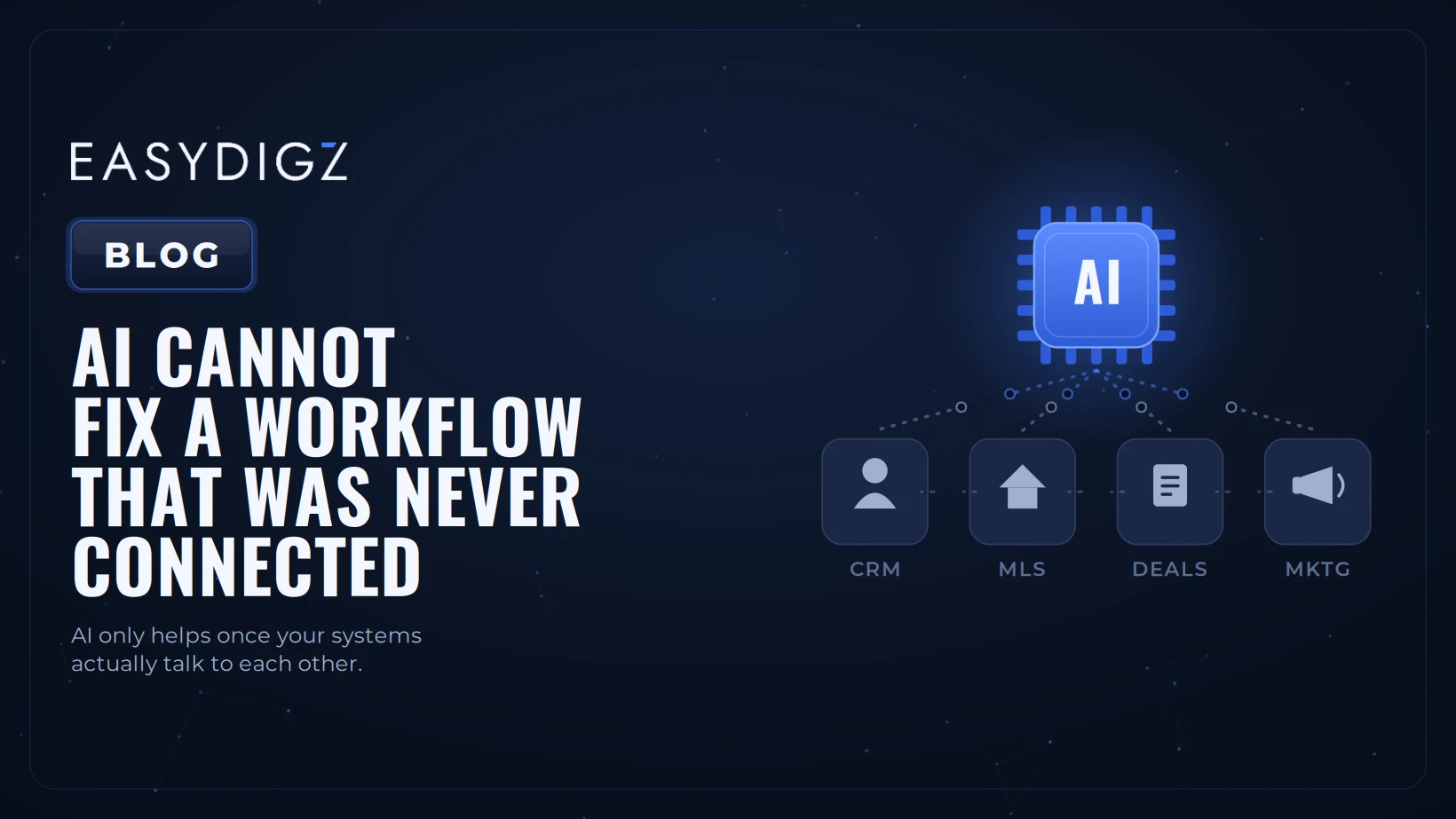
The whole industry is having one conversation right now, and you could see it play out across the floor at Inman Connect this summer, where it felt like every booth had AI on the banner, promising to write your listings, qualify your leads and follow up with your clients while you sleep. Some of that will turn out to be genuinely useful. But most of the brokerages being sold on it are going to run into something the demos tend to skip over, which is that AI does not fix a broken operation, it only runs a broken operation faster.
For years the independent brokerage has run on a stack of tools that were never built to work together, a CRM from one vendor, a transaction system from another, a lead source, a marketing tool and a calendar, each one handling its own slice and none of them sharing what it knows. What I keep hearing from brokers is that they have quietly become the integration themselves, moving information from one screen to the next and hoping nothing slips through. That is the real state of the business heading into all of this, and it is what decides whether the new technology helps anyone or just adds to the pile.
What the AI actually has to work with
Add it up and it is real money for very little in return. Plenty of agents are paying hundreds of dollars a month across different tools that still will not talk to each other, and losing deals anyway. Because the CRM does not talk to the MLS and the transaction side has no idea what marketing is doing. Each tool works fine on its own, but they do not work together, so the agent ends up spending half the day being the glue between them.
Now put an AI assistant on top of an operation like that and ask what it actually has to read. If your client information is spread across five places, the assistant only ever sees a fraction of the picture at a time, and if your transaction history has gaps, it draws its conclusions from around the gaps. People talk about AI as though it is going to understand your business, but it can only understand what it can see, and in most brokerages it cannot see much, because the information is scattered across tools that were never built to share it. What you get out of that is not intelligence so much as a faster version of the same confusion.
Consolidate first, then automate
The brokers who are going to get real value out of AI are the ones willing to do the boring work first, which means getting their client relationships, their transactions, their follow-up and their marketing into one place that actually connects. Once all of that lives in a single system the picture is finally whole, and a whole picture is the one thing every one of these AI tools needs before it can be worth the money.
I have said it a hundred times and I will say it here too, which is that you have to stop duct-taping your tech stack together. Every tool you bolt on brings another login, another silo and another thing to reconcile, and it tends to make you slower long before it ever makes you faster. What actually fixes the problem is not one more app with AI in the name but fewer moving parts that genuinely connect, so that when you do switch on automation there is something real underneath it.
Own the thing the AI runs on
There is one more piece to this that I care about, because I have watched too many good agents lose sight of it. Your data and your client relationships are the actual business, more than any logo on a portal or app of the month, and when that information lives inside a pile of disconnected tools you do not control, you end up renting access to your own market, which you feel every time you try to get a straight answer about your own pipeline.
Getting AI ready, when you get down to it, is really just getting your own house in order. Put your workflow into one place you own, so that a lead becomes a client and then a closing inside one connected record instead of being scattered across a handful of systems that do not talk, and the AI will finally have something worth reading. Skip that step and all you have really bought is an expensive tool that is now confused faster than you were before. So before you chase the next thing on the banner, take an honest look at whether your systems can even talk to each other yet, because that is the work that decides everything after it. If that is the conversation you are ready to have, we are always happy to talk it through.