

Ask a broker owner today whether their agents use AI and you will almost always hear yes. That question is settled. The one worth asking now is quieter, which is whether any of it is actually paying off. For a lot of independent shops the honest answer is not much and not yet, and the reason has very little to do with the tools and almost everything to do with what sits underneath them.
Everyone Is Using It Now
The adoption argument is over. A real estate leadership survey reported this August found that resistance has all but vanished, with the share of brokerages saying they have no plans for AI down to around two percent. Mid sized firms have caught up to the largest ones, and the tools are no longer a big company advantage. If you were waiting to see whether this was a passing thing, the waiting is done. Your agents are already using it, and so is every office you compete with.
Adoption Was Never the Hard Part
Here is where it gets interesting. Reporting from this June put a finer point on it. The real divide in the industry is not between the offices that use AI and the ones that do not. It is between the ones that rebuilt the way they work around it and the ones that simply bolted it on. Most of the time agents are saving is going into one place, which is responding to a lead faster, and the offices seeing genuine gains are the ones who treated AI as a way to move quicker through a process they already had in order. The tool did not create the advantage, the clean process behind it did.
Why It Stalls for Independents
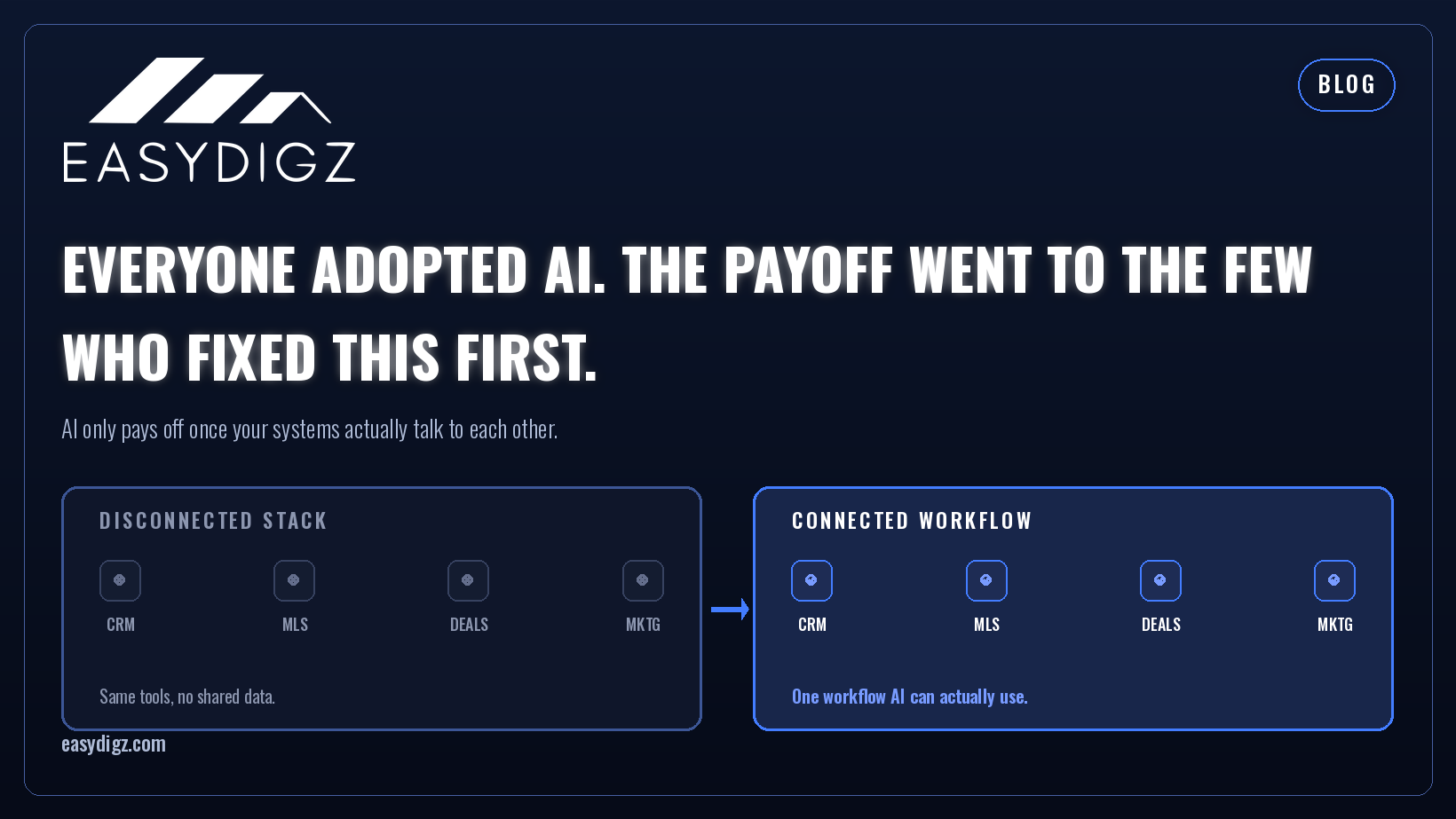
I have said for a while that the average independent is paying hundreds of dollars per month across a stack of disconnected tools, each one holding a different piece of the same business. Your leads are in one system. Your transactions are in another. Onboarding lives in a folder and a few email threads. Marketing runs somewhere else entirely. When you drop AI on top of that, it can only reach the shallow end of the pool. It can write a listing description or a social caption, because that kind of work needs only one box of information at a time. It cannot do the things that actually move a deal forward, because those things need to see across all of the boxes at once, and the boxes do not talk to each other.
That is the quiet trap. You end up renting access to your own market one login at a time, and any AI you bring in inherits the exact same walls you already live with. It is not that the tool is weak. It is that you have asked it to reason about a business it can only see one slice of, and no amount of cleverness gets around a view that narrow.
Consolidate First, Automate Second
This is the part I keep coming back to. Get your own house in order first. Every impressive thing people picture when they hear the word AI depends on connected information. Routing a new lead to the right person the moment it lands needs your contacts and your rules sitting in one place. Knowing where every deal actually stands needs your transactions visible in a single view rather than reconstructed from memory. Bringing on a new agent without anything slipping through the cracks needs onboarding that is a real system, not a habit that lives in one person's head. Offers and marketing are the same story. None of that is an AI problem. It is a plumbing problem, and AI only starts to shine once the plumbing is sound.
Market intelligence is the clearest example. A general AI tool will happily generate a market report, but most of what it returns is scraped and averaged rather than real, which is exactly the kind of output that makes people distrust AI in the first place. Run the same question against live, connected transaction data and you get something you can actually hand a client. Our July read of the Triangle market, pulled straight from MLS data, showed homes closing in about ten to seventeen days while unsold listings sat roughly three times as long, a split driven almost entirely by price. That is the kind of answer connected data makes possible and scattered logins never will.
It is worth noting that the same survey showing near universal adoption also found leaders increasingly want AI delivered through one connected platform rather than a drawer full of separate tools. The market is quietly arriving at the same conclusion the best operators reached on their own, which is to connect first and automate second. The order is not a detail. It is the whole thing.
Frequently Asked Questions
Do I need to consolidate my tools before using AI?
Not strictly, but disconnected data is the main reason AI adoption isn't paying off for most independent brokerages.Why isn't AI working for my agents even though we already use it?
Usually it's not the tool. The AI is pulling from fragmented systems instead of one connected source of truth, so it has nothing solid to work from.How is a connected brokerage platform different from just adding another AI tool?
A connected platform brings your listings, contacts, transactions, and marketing into one system first, so any AI layered on top is working from a single accurate picture instead of five disconnected ones.
Where to Start This Week
You do not need to buy anything to take the first step, and you should not. Before you add one more tool with the letters A and I in the name, do this:
1. List every place your client and deal information currently lives — lead tools, transaction tools, spreadsheets, shared inboxes, all of it.
2. Count them. If the answer is more than one or two, you have found your real project, and it comes before automation, not after.
3. Close that gap. The AI you already pay for quietly starts earning its keep.
4. Skip it, and no new tool will rescue you, because the problem was never the tool.
The brokerages seeing a real return on AI aren't the ones that bought the most tools. They're the ones that connected their data first, so whatever they automate is running on one coherent picture instead of five disconnected ones. That's what EasyDigz is built to do: it brings your listings, contacts, transactions, and marketing into a single connected system you own, so the AI you layer on top finally has a clean foundation to work from. Fix that first, and the payoff everyone else is still waiting on becomes yours to collect.
See how EasyDigz connects your brokerage's data into one system.