

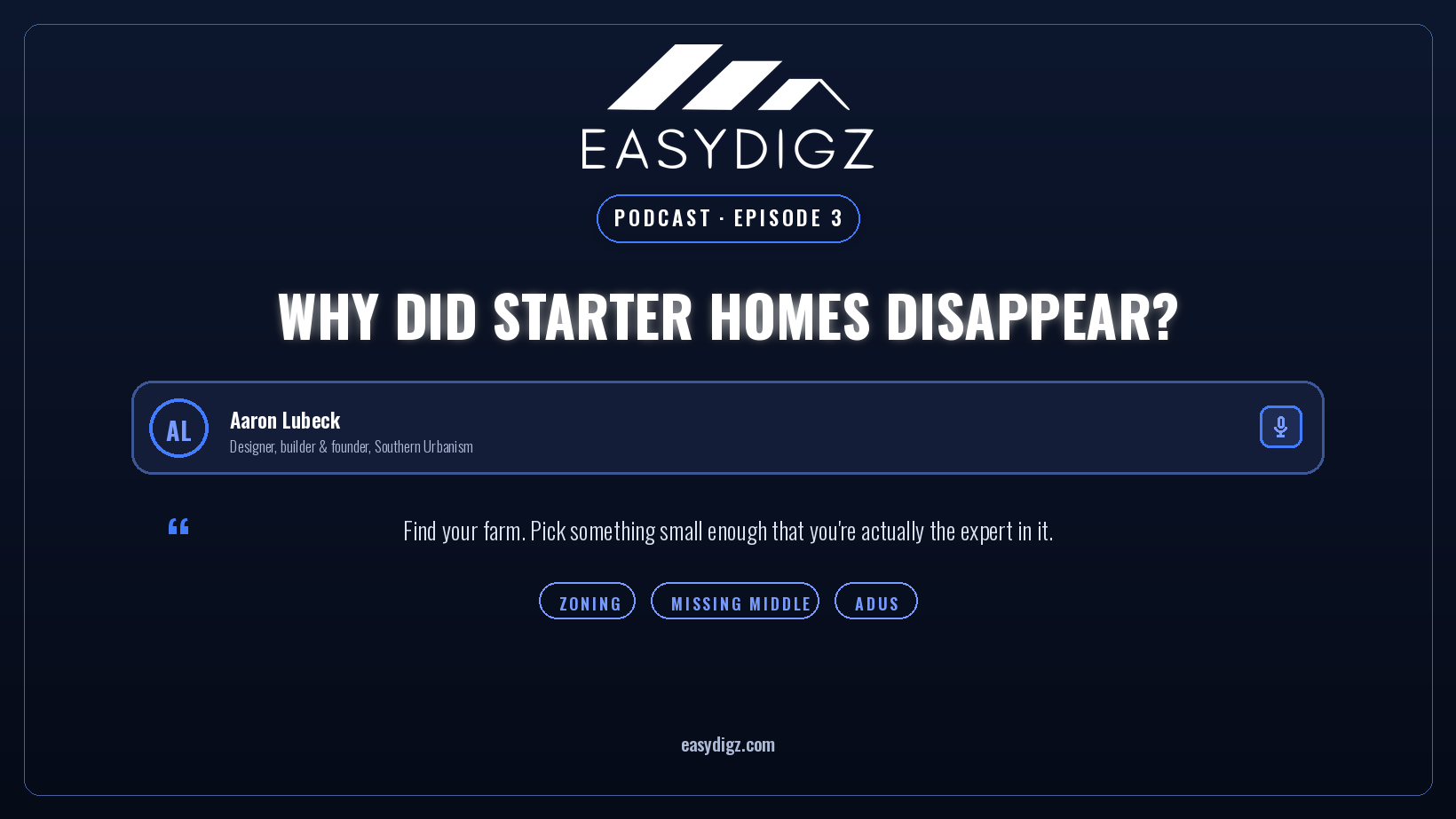
Starter homes didn't disappear by accident. For roughly a century, zoning codes across the country quietly made the housing that used to sit between the single-family house and the apartment block duplexes, cottage courts, and small-lot homes illegal to build in most places. That's the "missing middle," and it's the biggest reason your market has no starter homes left: the homes weren't priced out, they were zoned out.
This week Michael Walliser sat down with Aaron Lubeck, a designer, builder, and developer in Durham and the author of Green Restorations, for the newest episode of How It Runs, EasyDigz's interview series with the people shaping how housing actually gets built. Aaron has spent twenty years at the upstream edge of housing, the part that decides what's even allowed to get built before an agent ever lists it and the full conversation left me with more to chew on than almost any I've had on the show.
Here are five more ideas from the conversation worth carrying into your own market
Find Your Farm
Aaron credits this one to his mentor Monte Anderson, a founder of the Incremental Development Alliance, and the phrase is “find your farm.” It means pick a slice of the market definable enough that you can honestly become the expert in it. It can be a place, a single town or even one neighborhood, or it can be a type, accessory dwellings or main street buildings or duplexes in one suburb. The test is simple. If other people know more than you do, shrink your farm until you are the person they call. Aaron has coached young builders to the point where inside a year the answer to a question in their niche becomes "you have to call Jimmy, he is the duplex guy in Apex." For an independent that is the whole game, and it is reachable in months rather than decades.
Your Whole City Is One Shared Fund
This is the idea I keep turning over. Aaron borrows it from Chuck Marohn of Strong Towns. Picture all the property in your city as a single mutual fund that every resident owns a piece of. Whether you are a billionaire or you own nothing at all, you draw a return from it, because that shared value pays for the parks, the schools, the services and the roads. So when a homeowner puts a modest house in their backyard, with no subsidy and no cost to the city, they are not only adding a place to live. They are adding to the fund everyone lives on. It reframes what one small project is actually worth, and it is a genuinely useful way to explain to a skeptical room why reinvestment matters.
The Missing Middle, and Why It Went Missing
Aaron has spent years on what planners call the missing middle, the duplexes, cottage courts and small lot homes that were once an ordinary part of every neighborhood. His argument is that these were normal for generations and have become nearly impossible to build, not by accident but because a century of separated, car first zoning quietly made them illegal in most places. This is the thing brokers feel without always naming it. When you tell a buyer their market has no starter homes, this is a large part of why. The homes that used to sit between the single family house and the apartment block mostly stopped being allowed to exist.
Pocket Neighborhoods
If the missing middle is the problem, Aaron's favorite version of the answer is the pocket neighborhood, and it is a lovely thing to picture. Four to sixteen homes arranged around something shared, a green, a garden, a gazebo, even a bread oven. He hands clients Ross Chapin's book Pocket Neighborhoods, which traces how these have shown up everywhere from Denmark to Seattle. Aaron's read is that demand for exactly this kind of connected, human scaled place is climbing, and that the local independent builder is the one positioned to meet it. That is worth hearing if your market is full of drive only subdivisions and little else.
The Backyard House That Cannot Get a Loan
The most practical eye opener for me was about accessory dwellings, the granny flats and backyard cottages so many people say they want. Aaron's point is that the demand is already here and the thing stopping it is money, not desire. Appraisers have long discounted detached structures, sometimes by half, and the standard loan products were never built for them. So a family with good credit and a real plan often cannot finance a cottage that would let a parent live close or bring in a little income. Portland, he notes, once permitted more of these than detached single family homes. There is a real pool of housing sitting in people's backyards waiting for financing to catch up, and the agent who understands that will spot it before anyone
else does
The Five Ideas at a Glance
Find Your Farm — Pick a slice of the market narrow enough that you become the obvious expert in it.
Your Whole City Is One Shared Fund — Every new home, even one small backyard project, adds to the shared value every resident draws on.
The Missing Middle — Zoning, not demand, is why duplexes and small-lot homes disappeared from most neighborhoods.
Pocket Neighborhoods — Small clusters of homes built around shared space are a proven answer to the missing middle.
The Backyard House That Can't Get a Loan — ADU demand already exists; financing hasn't caught up.
Listen to the Full Conversation
That's what EasyDigz's How It Runs series is for: putting the on-the-ground knowledge independent builders and agents rarely get to hear out loud, on the record.
Listen to the full conversation with Aaron Lubeck Here