

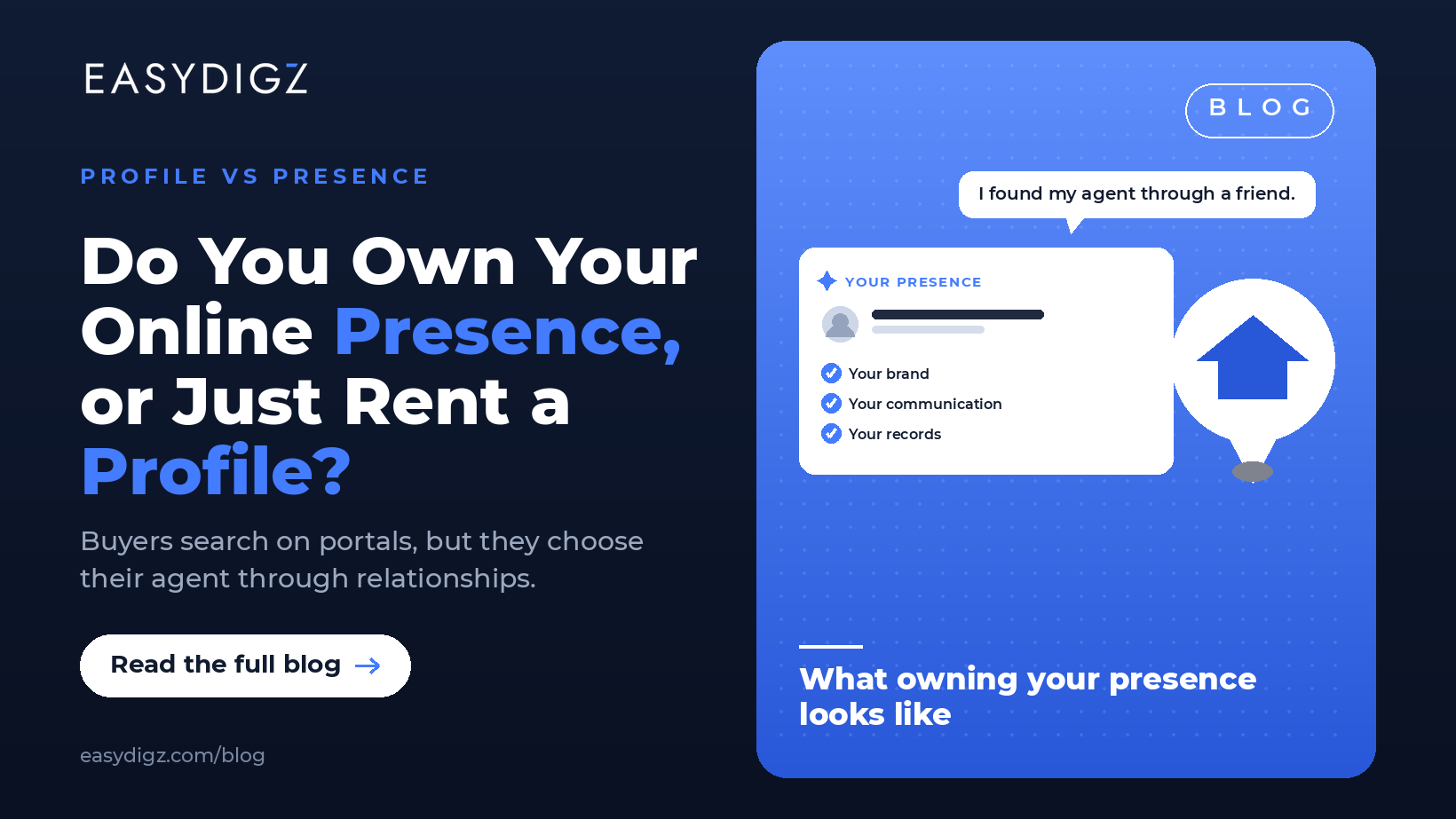
Nearly every agent has an online presence of some kind, and ask around a brokerage and most will say they have a website. Look closer and much of what gets called a website is really a profile on a larger branded portal. The difference is easy to overlook, and for years it did not seem to matter. It matters now, because a profile on another company's platform is not the same as a presence that belongs to the agent, and the gap shows up where it counts most, in the relationship with the client.
The numbers point the same way. In the National Association of Realtors' 2025 Profile of Home Buyers and Sellers, 52% of buyers found the home they purchased on the internet, yet 43% chose their agent through a referral from a friend, neighbor or relative, more than any online source. Buyers search on portals, but they still pick the person they trust through a relationship.
A profile and a presence are not the same thing
An online profile is a page the agent fills in on a platform that keeps its own brand wrapped around it. The agent adds a photo, a short bio and a few listings, and the platform owns the frame, the traffic and often the lead. A presence that belongs to the agent carries the agent's own brand, with no other company placed between the agent and the client.
Why so many agents settled for a profile
This was a reasonable choice, not a careless one. Agents are stretched thin and expected to be visible everywhere at once, and a profile was quick to set up and usually free. The limit only becomes clear later, when the thing an agent most needs to protect is the relationship with the client.
The relationship is where the business actually is
Buyers lean on portals to look at homes, but they hire and rehire agents through people they trust. That is why referrals and repeat clients carry so much of a healthy business. A portal profile can help a buyer find a listing, but it does little to build the trust that turns into the next referral, because that trust lives in the relationship rather than on the platform.
What owning your presence really means
Owning a presence is less about a large website and more about control. It means the client experience, the communication channels and the record of what the agent did for each client sit somewhere the agent and the brokerage control. When all of that belongs to the agent, the client works with their agent directly, from the first search to the closing table and beyond.
It ties directly to the duty you owe the client
An agent's responsibility is to represent the client's interest across the whole transaction. When the presence, the messages and the record of the work sit on a third party's platform, the agent cannot hold a consistent standard for what the client can expect at each step. Ownership is what makes that standard possible, and it is also what gives the agent a record showing the standard was met.
Where the brokerage comes in
This is easier to hold as a shared standard than as something each agent remembers alone. When agent sites, client communication and transaction records are tied to one system the brokerage controls, keeping the client relationship becomes the default rather than a task that depends on which tools an agent happened to stitch together.
A simple place to start
Pick one presence the agent actually controls and point every profile back to it.
Run client communication through channels the agent owns, not a portal's inbox.
Keep the record of what was done for each client in one place the brokerage can see.
Treat portal profiles as one more way to be found, not as the home of the relationship.
Being listed is not the same as being chosen
Showing up on a portal can start a search. What earns the business is the experience the client has after they reach out, and whether the agent still holds the relationship a year later when it is time to refer a friend. That is why the foundation matters more than any single profile. When client records, marketing and transactions live in one connected system, the agent owns the relationship that a portal only ever borrows.
Key Takeaways
An online profile on a branded portal is not the same as owning your presence, because the platform owns the frame and often the lead.
In NAR's 2025 Profile, 52% of buyers found their home online, but 43% chose their agent through a referral rather than an online channel.
Buyers use portals to find listings and relationships to find agents, which is where repeat and referral business comes from.
Owning your presence means the client experience, the communication and the record of your work sit somewhere you control.
Ownership is what lets an agent hold, and prove, a consistent standard for what a client can expect.
Frequently Asked Questions
What is the difference between an agent profile and owning an online presence? A profile is a page an agent fills out on a larger platform that keeps its own branding around it. Owning a presence means the page, the client communication and the record of the work belong to the agent, with no other company's brand between the agent and the client.
Do agents still need to be on the big portals? Being listed where buyers look can help a listing get found, so portals can play a part. The point is to treat them as one channel rather than the place the client relationship lives.
Does owning a presence mean building a big website? No. It is less about size and more about control. A simple presence the agent owns, with client communication and records in one place, does more than an elaborate page on someone else's platform.
Why does this matter for serving clients well? Representing a client well means holding a clear, consistent standard across the whole transaction, which is far easier when the tools carrying the relationship belong to the agent rather than to a platform that can change its terms at any time.
Want the client relationship to stay with your agents instead of the portal? Talk it through with EasyDigz.