

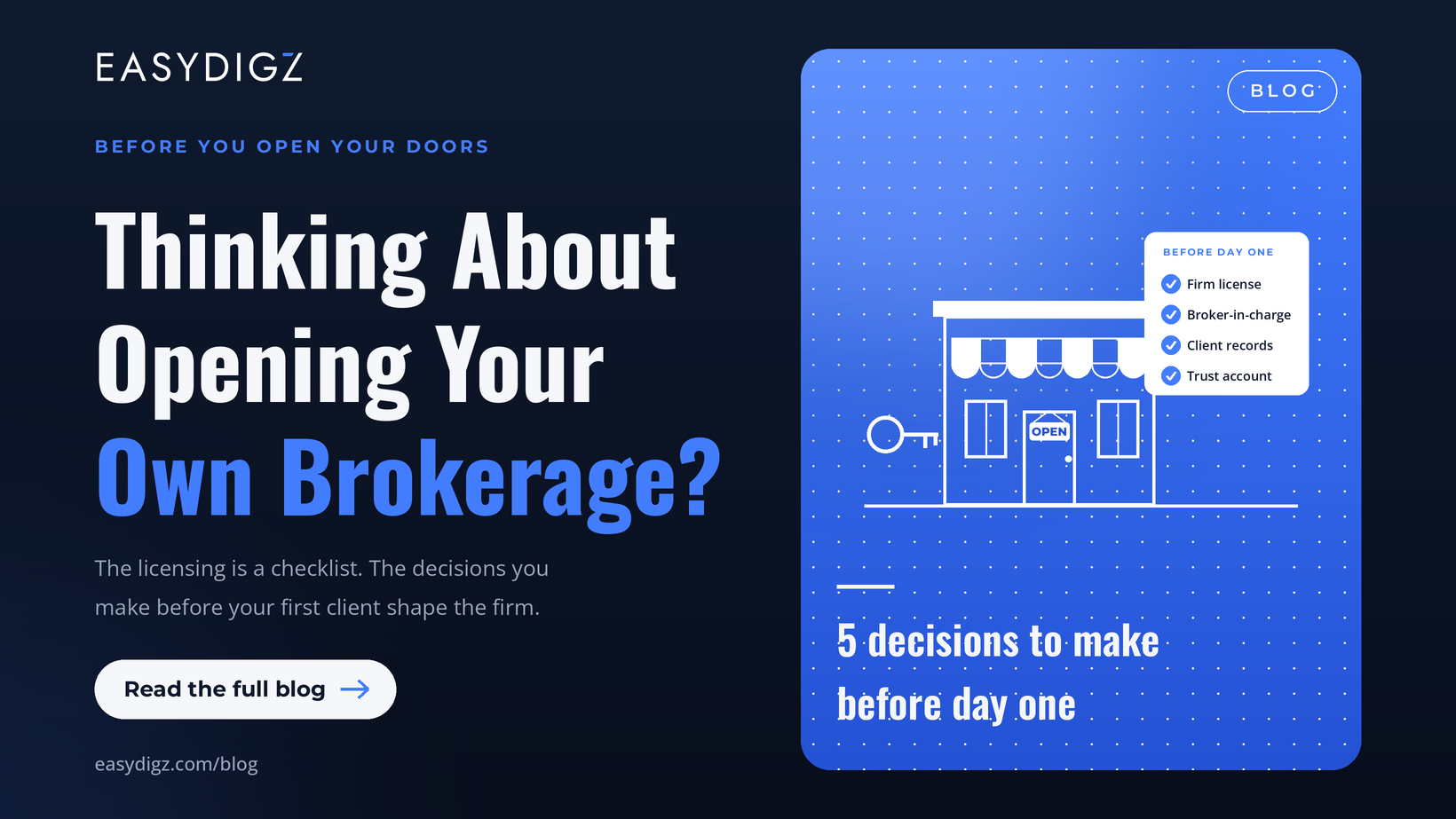
At some point many brokers start to wonder what it would look like to go out on their own. Maybe they have built a strong base of past clients, maybe they want to set their own standard of service, or maybe they simply know they could run things differently. Opening a firm in North Carolina comes down to two jobs: meeting the Real Estate Commission's licensing requirements, and deciding how the business will actually run before the first client signs anything. The first job is a clear checklist. The second is where most new firms either set themselves up to grow or spend their first year cleaning up.
What the Commission requires before you open
The licensing steps are well documented, and the Commission's own pages are the best place to confirm each one before you apply.
A firm license for your business entity. According to the Commission, every business entity other than a sole proprietorship needs a firm license before it engages in brokerage. That applies whether you form an LLC, a corporation or a partnership, and it applies even if the entity exists only to receive compensation. The application asks for the entity's legal and assumed names, its Secretary of State ID, the address of every office, a qualifying broker and a broker-in-charge for each office location.
A qualifying broker who is responsible for the firm itself. The qualifying broker must be a principal of the firm with an active broker license in good standing. The Commission lists that person's duties, which include making sure every office has a broker-in-charge, renewing the firm's license each year and preserving the firm's transaction and trust account records whenever the broker-in-charge changes.
A broker-in-charge for each office. To be designated broker-in-charge of a sole proprietorship, a firm or a branch office, a broker first needs BIC Eligible status. The Commission's BIC course FAQ explains that this includes completing the 12-hour Broker-in-Charge Course, a self-paced online course, no earlier than one year before and no later than 120 days after applying for that status. A broker-in-charge who takes on a trust account must also complete the Commission's Basic Trust Account Procedures Course within 120 days of assuming it.
None of this is unusual for a licensed profession, and the Commission's Education and Licensing Division can answer questions about a specific situation.
The decisions that come before your first client
Once the paperwork is in motion, the more important questions are about how the firm will operate day to day. These are much easier to answer at the start than to fix later, when clients, agents and records are already spread across different places.
Where will client relationships live? Most of a broker's business comes from people they have already served. If those relationships sit in a personal phone, an old inbox and a spreadsheet, the new firm is starting with its most valuable asset scattered. Deciding on one home for every client record from day one means the firm actually holds the relationships it builds.
How will money and records be kept? The Commission is clear that the firm is responsible for its transaction and trust account records. A new broker-owner should know exactly where each file, signed document and ledger entry will be stored and who can find it if something is ever questioned.
How will the firm be found? A new firm needs a name, a website and consistent information everywhere a client might look, from the firm's own site to social profiles and listing pages. When those details match, clients and referral partners can trust they have found the right business.
How will the broker-in-charge see what is happening? Supervision is part of the job description. Even a firm of one or two agents benefits from being able to see where every deal stands without calling around to ask.
What can every client expect? Going out on your own is often about setting a higher standard. Writing down what a client will hear from the firm at each stage, and when, turns that intention into something every agent can deliver.
Why setting up the system first matters
Most brokers who open a firm are already stretched. They are serving clients, recruiting, marketing and learning the administrative side of the business all at once, and it is natural to grab whatever tool solves the problem in front of them that week. The trouble is that each quick fix adds another place where information lives, and a few months later the broker-owner is spending evenings stitching records back together.
Starting with one connected system for clients, transactions, documents and marketing avoids that. It gives the broker-in-charge a clear view of the business, it keeps the firm's records in order for the Commission and it gives every client the same experience no matter which agent they work with. Consolidating first and automating second is far easier on day one than in year three.
Key Takeaways
In North Carolina, every business entity other than a sole proprietorship needs a firm license from the Real Estate Commission before engaging in brokerage.
Each firm needs a qualifying broker, and each office needs a broker-in-charge with BIC Eligible status, which includes the 12-hour Broker-in-Charge Course.
A broker-in-charge who takes on a trust account must complete the Basic Trust Account Procedures Course within 120 days.
The decisions that shape a new firm's first year are operational: where client relationships live, how records are kept, how the firm is found, how the broker-in-charge supervises and what every client can expect.
Setting up one connected system before taking the first client is much easier than consolidating scattered tools later.
Frequently Asked Questions
Do I need a firm license if I operate as a sole proprietor? No, a sole proprietorship doesn’t need a separate firm license. Whether you also need to be a broker-in-charge depends on how you run the business. If you plan to hold clients’ money, market your services or bring other brokers on board, you will need that status, which covers most people opening a brokerage. It’s worth a quick check with the Real Estate Commission to confirm what applies to you.
How do I take the Broker-in-Charge Course? The Commission offers the 12-hour Broker-in-Charge Course as a self-paced online course through its learning platform, and its FAQ lists the registration fee as $110. The course must be completed no earlier than one year before and no later than 120 days after applying for BIC Eligible status.
What should a new broker-owner set up first? After licensing, the first priority is deciding where client relationships and transaction records will live. When that foundation is in one place from the start, marketing, supervision and client service all have something solid to build on.
Is it too early to think about systems if the firm is only one or two agents? No. A small firm is actually the easiest time to set this up. There are fewer records to move, fewer habits to change and the standard the firm sets now becomes the standard every future agent learns.
Thinking about going out on your own and want to get the foundation right? Talk it through with EasyDigz.