

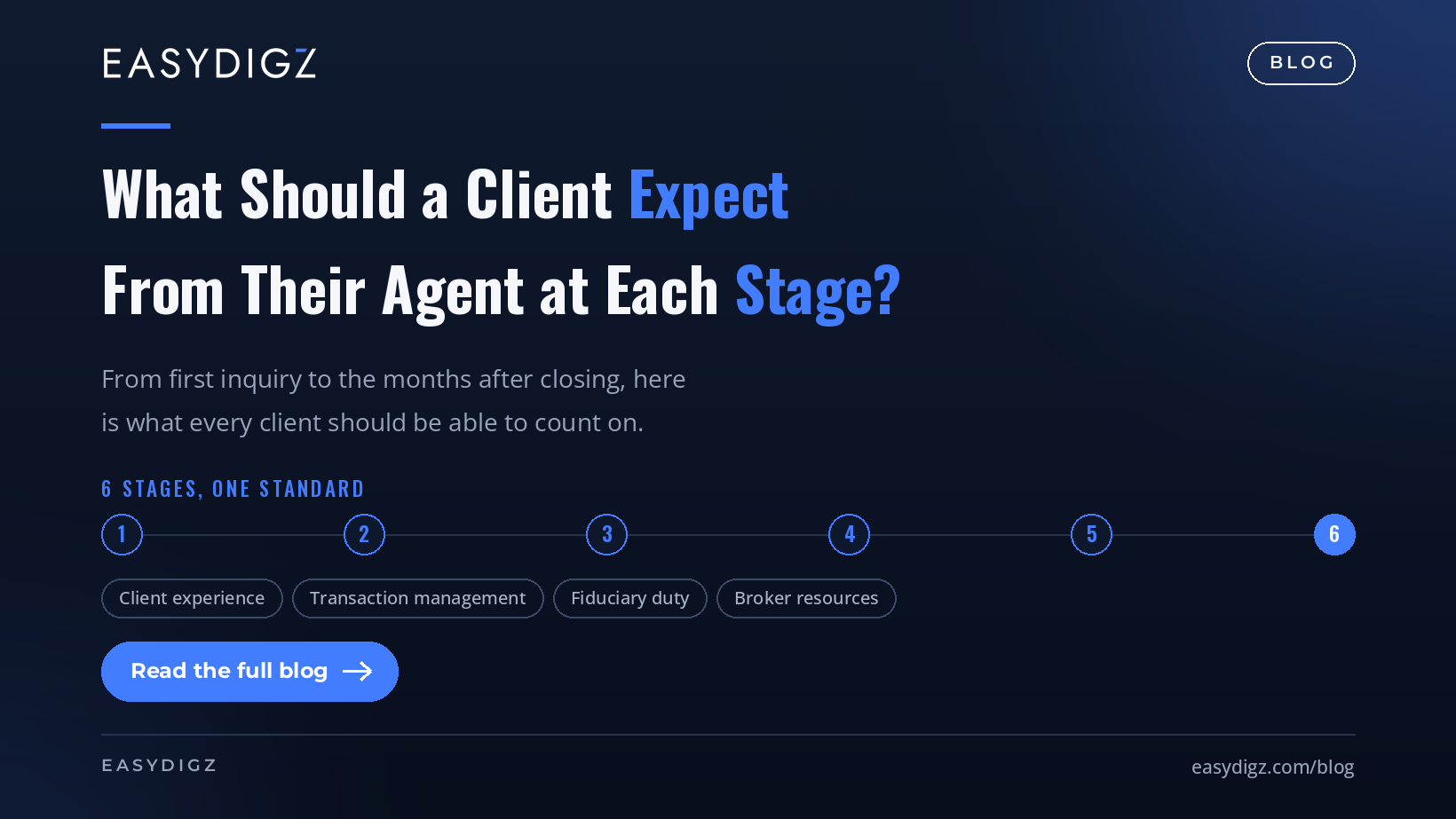
A client working with a real estate agent should be able to count on a timely response at first contact, a clear explanation of the working relationship, regular updates during the search or listing period, accurate guidance when offers are made, a managed path through every deadline to closing and continued contact after the keys change hands. Most clients never see that list written down, which is why the experience can vary so much from one agent to the next, even inside the same brokerage. A brokerage that sets the standard for each stage, rather than leaving it to each agent, gives clients something reliable and gives agents a clear picture of what good work looks like.
Agents are often stretched across marketing, negotiation, paperwork and client care at once, and few of them have a single place that shows what has already been done for a given client. A shared standard is less about adding pressure and more about making sure nothing falls through the gaps when the work gets busy.
Stage 1: First contact
The first thing a client should expect is a real response, not an automated reply followed by silence. In residential real estate, the gap between an inquiry and a meaningful conversation can stretch into weeks, and a client who waits that long often assumes the agent is not interested. A brokerage standard at this stage sets how quickly a new contact hears from a person and how that client will be kept informed going forward.
Stage 2: Understanding the relationship
Before any homes are shown or any listing goes live, a client should understand who the agent represents, what services are included and what the agreement between them says. The standard here is a plain conversation and a written record of it, so that the client is never guessing about the terms of the relationship later in the process.
Stage 3: The search or the listing period
This is the stage where clients most often feel out of the loop. A buyer should know how new properties will be shared and how often the agent will check in, and a seller should receive regular updates on showings, feedback and how the property is being presented. A brokerage that defines the update cadence for this stage removes much of the uncertainty clients describe when they look back on a transaction.
Stage 4: Offers and negotiation
Accuracy matters most at this stage, because clients make decisions based on what their agent tells them. The North Carolina Real Estate Commission's September 2026 eBulletin reminds brokers that in North Carolina a verbal acceptance of an offer does not create an enforceable contract. As of that bulletin, a binding sales contract requires a written agreement signed by all parties, with notice that everyone has signed communicated to the other side. The Commission also advises brokers never to describe an offer as "verbally accepted," since the phrase can lead a client to believe a deal exists when it does not. A client should expect their agent to explain exactly where an offer stands and what still has to happen before it becomes a contract.
Stage 5: Under contract to closing
Once a contract is signed, the work shifts to deadlines, inspections, repairs, financing and the many people involved in getting to the closing table. A client should know which dates matter, who is responsible for each step and what the agent has already handled. Keeping a record of that work is part of the agent's duty to the client, and it is the only way a broker can confirm that the standard was actually met.
Stage 6: After closing
The relationship does not end at closing, and for most agents it should not. In its 2026 Member Profile feature sheet, published August 19, 2026, the National Association of REALTORS® reported that the typical member earned 28% of their 2025 business from repeat clients and 22% from referrals. A client should expect to hear from their agent after the sale, whether that is help with a question about the home or a simple check-in, and a brokerage that sets this standard protects the relationships its future business depends on.
A standard needs a record behind it
None of these expectations hold up if the record of what was done for a client is scattered across personal phones, inboxes and spreadsheets. The Commission's September 2026 Tech Corner article makes a related point, noting that most client records and business information now live online and encouraging brokers to keep an organized inventory of the accounts and records their business relies on. A brokerage that brings client communication and transaction history into one place can see, at any stage, whether each client received what they were promised.
The most practical place to begin is to write the six stages down, add one sentence under each describing what every client of the brokerage should receive and share that page with every agent. It becomes both a promise to clients and a checklist for the people delivering on it.
Key Takeaways
Clients should be able to count on a consistent experience at every stage, from first contact through the months after closing.
Setting that standard at the brokerage level, rather than leaving it to each agent, reduces the variation clients notice.
As of the NC Real Estate Commission's September 2026 eBulletin, a verbal acceptance does not create an enforceable real estate contract in North Carolina.
Post-closing contact matters because NAR found that roughly half of a typical member's 2025 business came from repeat clients and referrals.
A standard is only as reliable as the record that shows it was met.
Frequently Asked Questions
- How often should an agent update a client during a home search or listing?
There is no single required schedule, in our understanding. Our view is that the right cadence is the one agreed with the client at the start and then followed consistently. - Can a seller verbally accept an offer in North Carolina?
According to the North Carolina Real Estate Commission's September 2026 eBulletin, a verbal acceptance does not create an enforceable contract. The Commission states that a written agreement signed by all parties is required, along with communication that all parties have signed. - Why should a brokerage set client expectations instead of each agent?
Our read is that a brokerage standard gives every client the same baseline experience and gives the broker a way to confirm that the work was done, regardless of which agent handled the transaction. - What should a client do if they are unsure where their transaction stands?
We would encourage the client to ask their agent directly for the current status, the next deadline and who is responsible for it, since a well-run transaction should be able to answer all three at any time.
EasyDigz transaction management workflows are built on exactly this idea of defining what happens at each stage, and the share settings in the client dashboard keep clients informed so they are not left out of the loop. If you want one consistent standard for every client of your brokerage, talk it through with the EasyDigz team.